
Revenue cycle automation applies software, rule engines, and AI to the administrative work of billing, so claims move from service to payment with fewer manual touches and fewer errors. The primary payoff is financial: faster cash collection and lower denial rates. The sections below map automation to each stage of the revenue cycle and show how a code-validation platform fits into that work.
TL;DR:
- Start with one high volume, high error workflow, such as claim scrubbing or eligibility checks, and measure denial and rework changes before expanding.
- Clean workflows and validate data exchange between billing systems before launch; keep human review for exceptions, with audit logs and privacy controls.
- Check AI suggested codes against certified coder output through scheduled dual validation, and set an acceptance threshold before the pilot begins.
- Track clean claim rate, denial rate by category, accounts receivable days, and cost to collect; compare rework and cash measures over a medium term window.
Table of Contents
- What revenue cycle automation means and how it differs from manual RCM
- Main benefits of automating the revenue cycle
- How automation enhances each step of the revenue cycle
- Practical use cases worth piloting first
- Implementation prerequisites, challenges, and governance
- A short example of automation’s measurable impact
- How Health Code Index applies automation to coding and claims validation
- What success looks like for automation projects
- How we can support your automation plan
- FAQ
- Sources
What revenue cycle automation means and how it differs from manual RCM
Revenue cycle automation refers to technology that replaces manual, repetitive billing tasks with rule-based or AI-driven processing. It is not one tool but a set of components that work together:
- Rule engines apply coding and payer rules automatically, flagging claims that violate them before submission.
- Robotic process automation (RPA) handles repetitive data entry and routing tasks, such as moving a claim from one queue to another.
- NLP and AI extract and interpret clinical documentation to support coding decisions.
- Claim scrubbers check claims against payer and regulatory requirements before they leave the building.
- APIs connect these tools to practice management and hospital information systems, so data moves without re-entry.
Task automation handles a single repetitive step, like data entry. Workflow orchestration links several automated steps into one continuous process, from eligibility check to claim submission. Coding standards such as ICD-10 and CPT-4/CCSA anchor all of it. Automated tools still have to produce claims that follow the same formatting and specificity rules a human coder would.
Main benefits of automating the revenue cycle
Automation’s value shows up in a handful of measurable places. Coding accuracy improves because rule engines catch mismatches and missing modifiers before a claim goes out, which cuts both denials and the rework that follows them. Adjudication speeds up when clean claims move through payer systems without manual intervention, which shortens accounts receivable days and improves cash flow. Staff time shifts away from repetitive data entry toward exception handling and patient-facing work, which lowers administrative cost per claim. Patients also benefit: automated estimates and point-of-care billing reduce surprise charges and make collection easier.
- Fewer denials and less rework from upfront rule enforcement.
- Shorter AR cycles as clean claims clear faster.
- Lower administrative cost per claim processed.
- Better patient billing experience through upfront estimates.
Net revenue losses tied to final denials and bad debt grew significantly in 2025. That increase in denial-driven revenue loss is exactly the kind of leakage that automated claim scrubbing and denial prevention workflows are built to reduce. The KPIs worth tracking are clean-claim rate, denial rate by category, days in AR, and cost to collect.
How automation enhances each step of the revenue cycle
Automation touches the front end, the middle, and the back end differently, and each stage calls for a different kind of tool.
- Front end: Pre-registration and eligibility verification run automatically against payer databases, and price estimation tools generate patient-facing quotes before service, cutting the manual phone calls that used to confirm coverage.
- Middle: Clinical documentation feeds AI-assisted coding tools, and pre-bill scrubbers check every claim against payer-specific and regulatory rules before it is submitted, catching mismatches a human reviewer might miss under volume.
- Back end: Claims route automatically after submission, AR follow-up tools flag aging accounts, and denial triage sorts rejected claims by root cause so staff can prioritize appeals automation handles the repetitive drafting first.
Technology patterns repeat across all three stages: APIs connect automation tools to practice management systems, claim scrubbers enforce rules at the point of submission, and RPA routes work between queues without manual handoffs.
Pro Tip: Pilot automation on one high-volume claim type first, so you can measure denial and rework reduction before expanding scope.
Leaders should focus pilots on a few high-volume, high-error workflows and measure outcomes over a medium-term window rather than judging a tool after a few weeks.
Practical use cases worth piloting first
Four use cases tend to deliver the clearest early wins:
- Automated coding with dual-coding validation, where AI-suggested codes are checked against certified coder output on a sample basis, with errors triaged by category.
- Eligibility and prior-authorisation automation, which clears routine cases automatically and routes exceptions to staff.
- Pre-submission scoring and claim scrubbing, which raises the clean-claim rate by catching formatting and rule violations before a payer ever sees the claim.
- Denial prevention and automated appeals drafting, which uses root-cause data to stop repeat denials and speeds up the appeal process for the ones that still happen.
Each of these can run as a contained pilot with its own success metric, which makes them easier to justify and easier to scale once they prove out.
Implementation prerequisites, challenges, and governance
Automating a broken process only makes the breakage faster. Process mapping and cleanup come first, before any tool goes live. Data quality matters just as much: practice management and hospital information systems need to exchange clean, correctly formatted data, including ICD-10 codes submitted with the specificity, delimiters, and sequencing South Africa’s technical guidance requires for electronic claims.
- Map and clean workflows before introducing automation, not after.
- Validate data exchange between automation tools and existing PMA/HIS systems.
- Build in human-in-the-loop review for exceptions and edge cases.
- Set governance controls, including version history, audit logs, and compliance checkpoints.
Treating automation as enterprise process engineering, not a bolt-on tool, is the pattern behind successful AI integration in revenue cycle functions. Dual-validation sampling, where AI output is checked against certified coder output on a defined schedule, is a core part of that governance, along with privacy safeguards for patient data throughout the pipeline.
Pro Tip: Set your dual-coding acceptance threshold before launch, not after you see the first batch of results.
A short example of automation’s measurable impact
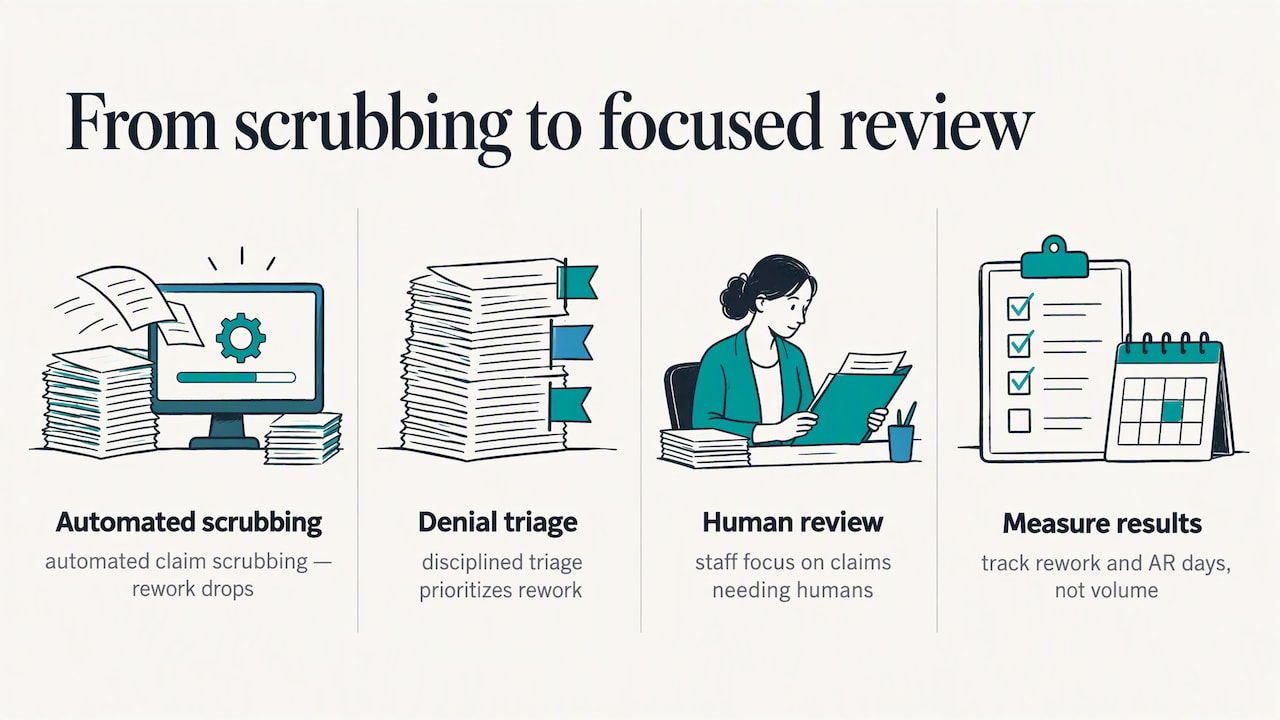
Industry benchmarking shows the direction clearly: organisations with strong revenue cycle execution improved cash metrics even as denial-driven losses rose industry-wide. The common thread in these cases is automated claim scrubbing paired with disciplined denial triage, so rework drops and staff attention moves to the claims that actually need a human.
Our key takeaway for anyone piloting a similar project: measure rework and AR days before and after, not just claim volume.
How Health Code Index applies automation to coding and claims validation
We built our platform around the coding and validation work that sits in the middle of revenue cycle automation. Our tools check medical codes against current rules and can alert you to enforce scheme-specific requirements automatically at the point of submission.
- We validate codes and claim structure before submission, reducing the rework that comes from preventable rejections.
- We enforce scheme rules automatically to support organisations billing multiple schemes with different requirements.
- We connect via API to existing practice management and hospital information systems, allowing validation inside familiar workflows.
See our use cases and medical scheme solutions for more detail on how these pieces fit together.
What success looks like for automation projects
Start small, with one workflow and a clear KPI, and build governance in from day one rather than bolting it on later. Invest in process mapping and staff enablement before scaling. Track short-term operational wins alongside medium-term financial impact, because the real payoff takes longer to show up than the first demo does.
How we can support your automation plan
Wherever you are in mapping out automation, our service overview covers the code search, claims processing, and compliance checking work most teams start with. For API and HIS integration planning, our integration page outlines what connecting to your existing systems involves.
Request a walkthrough of our platform to see how code validation fits into your current claims workflow.
This article is general information, not a substitute for advice from a qualified financial advisor. Consult a qualified financial professional about your own circumstances before acting on anything here.
FAQ
What is revenue cycle automation?
Revenue cycle automation uses software, rule engines, and AI to handle repetitive billing tasks like eligibility checks, coding, and claim scrubbing without manual intervention at every step. The goal is fewer errors and faster payment, achieved by applying payer and coding rules automatically before a claim is submitted.
What are the seven steps of the revenue cycle?
The revenue cycle generally runs through pre-registration, registration, charge capture, coding, claim submission, payment posting, and denial management or follow-up. Automation can touch each of these steps, though the specific tools differ between front-end tasks like eligibility verification and back-end tasks like denial triage.
What are five examples of automation in this context?
Common examples include automated eligibility verification, AI-assisted medical coding, pre-submission claim scrubbing, automated denial routing, and automated appeals drafting. Each targets a different point in the billing process where manual review previously slowed claims down or introduced errors.
What are three ways AI can improve revenue cycle management?
AI can assist medical coding by suggesting codes from clinical documentation, which still benefits from dual-coding validation against certified coder output. It can also score claims before submission to flag likely denials, and it can draft structured appeals language for claims that are rejected, both of which McKinsey identifies as promising applications when piloted with proper validation.
Sources
- Setting the revenue cycle up for success in automation and AI — McKinsey
- Compliant and effective AI integration in revenue-cycle functions — Protiviti
- South African ICD-10 technical user guide — National Department of Health
- Healthcare provider organizations saw net revenue losses grow by 25% in 2025 — Kodiak Solutions / BusinessWire