

Automated claims processing cuts cycle times, lowers cost per claim, and reduces manual error by combining AI and machine learning, intelligent document processing (IDP and OCR), robotic process automation (RPA), and workflow engines connected through APIs. These systems triage, extract, validate, and route claims with far less manual touch. None of it works without human review, audit trails, and governance built in from the start.
TL;DR:
An integrated framework reported roughly a 50% reduction in manual intervention, but treat that result as a directional benchmark, not a guaranteed outcome.
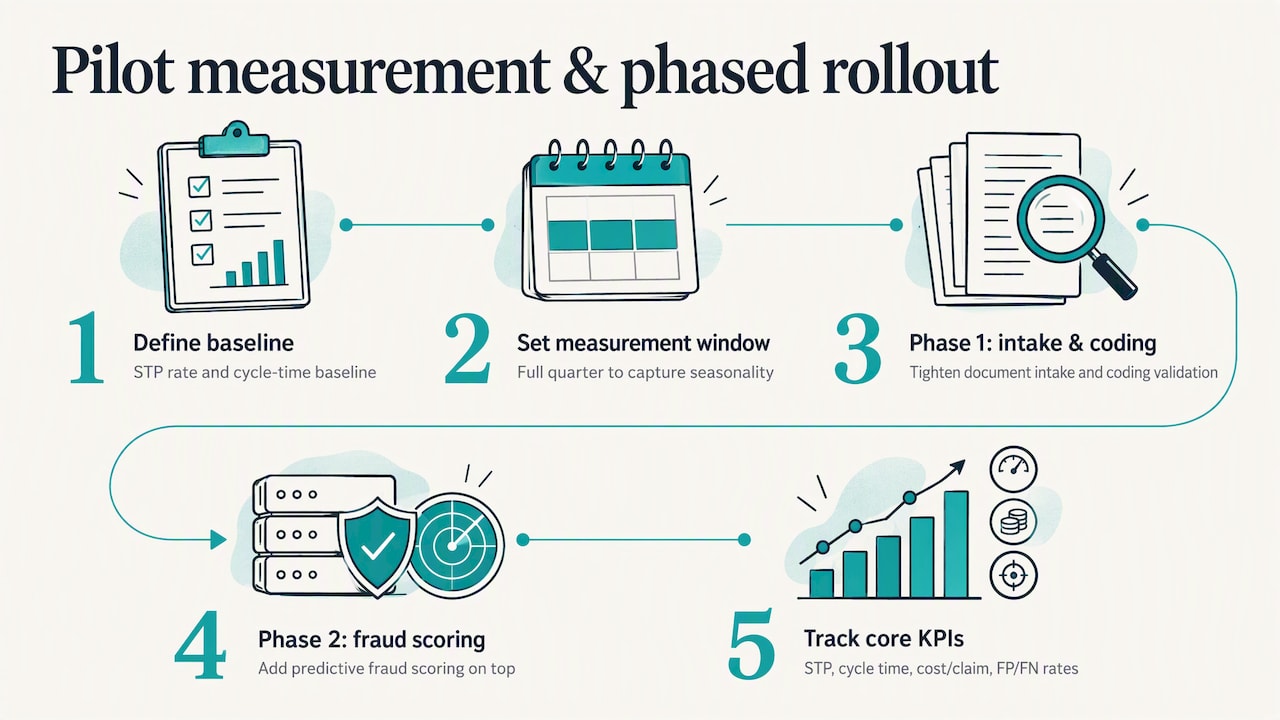
Start with document intake and coding validation, then add fraud scoring; measure the baseline STP rate and cycle time over a full quarter.
Route low confidence extractions to human reviewers, log every automated decision, and set model testing, drift monitoring, and rollback rules before launch.
Insurers outsourcing material claims work need documented risk assessments and formal approval, while transfers of health data across borders face specific restrictions under POPIA.
Table of Contents
-
Operational challenges that make claims automation necessary
-
Quantifying benefits and ROI: what improvements insurers typically see
-
Implementation and governance checklist for a compliant rollout
-
Practitioner example: code-aware validation and API integration in claims automation
Operational challenges that make claims automation necessary
Manual claims handling is slow by design. A claim moves from first notice through intake, coding, adjudication, and payment, and every handoff between departments adds delay. Cycle times stretch when adjusters wait on paper forms, scanned invoices, or physician notes that have to be read, interpreted, and typed into a core system by hand.
That manual re-entry is also where errors creep in. A miskeyed procedure code or a missed modifier can trigger a denial, and the rework to fix it costs more than getting it right the first time. Unstructured inputs make this worse: handwritten clinical notes, PDF invoices in inconsistent formats. None of it arrives ready for a rules engine to read.
Legacy systems compound the problem. Claims data often sits in silos across underwriting, provider networks, and finance, so a claim that should resolve in a single pass instead bounces between systems that cannot talk to each other. Fraud review suffers under the same constraint: human reviewers can only sample a fraction of claims, which means most anomalies go unchecked simply because there is not enough reviewer capacity to look.
The pain points insurers most need to address when scoping an automation pilot are:
-
Long FNOL-to-payment timelines driven by manual handoffs between departments.
-
Coding and data-entry errors that cause denials and costly rework.
-
High volumes of unstructured documents (photos, PDFs, clinical notes) that slow adjudication.
-
Siloed legacy systems that block straight-through processing.
-
Limited human review capacity that leaves fraud detection thin at scale.
Core technologies that enable automated claims processing
Claims automation is not one tool. It is a stack of capabilities, each handling a different part of the claim lifecycle.
Intelligent document processing and OCR extract structured fields from forms, photos, and invoices, attaching confidence scores so low-certainty extractions route to a human reviewer instead of flowing straight through. Natural language processing handles the unstructured side: pulling relevant clauses from policy documents, summarizing clinical notes, and indexing claims for faster retrieval. A collaborative AI system called Clais demonstrated this kind of rule-extraction approach directly, automatically pulling human-interpretable compliance rules from policy documents and reaching near-perfect precision and recall on validated rules in a user study, while still routing edge cases to a human curator for adjustment.
Predictive AI and machine learning models handle triage scoring and fraud analytics, flagging anomalies for review with explainability built in so adjusters can see why a claim was flagged. RPA and decision engines execute the deterministic parts: rule checks, system updates, low-code workflow logic that does not need judgment calls. Newer agentic and LLM-based assistants are starting to support tasks like document synthesis and prior authorisation review. A 2024 study on LLM agents for medical necessity justification found GPT-4 reached high accuracy levels on checklist item-level judgments and overall checklist judgments, demonstrating strong performance for this task, a useful benchmark for what this class of tool can and cannot be trusted to do unsupervised.
The pieces that typically make up a working stack:
-
IDP/OCR for extracting structured data from scanned and photographed documents.
-
NLP for clinical and policy text summarisation and indexing.
-
Predictive ML for triage scoring and fraud anomaly detection.
-
RPA and decision engines for rule execution and system orchestration.
-
LLM-based assistants for document synthesis, used with oversight.
Pro Tip: Treat each technology as a module feeding a shared orchestration layer rather than a standalone fix, since point solutions tend to create new silos instead of removing old ones.
Orchestration matters as much as any individual model. A Guidewire-integrated AI framework reported roughly a 50% reduction in manual intervention when AI and IDP components were routed through a core claims system that preserved audit trails and handled event-driven integration across modules.
Quantifying benefits and ROI: what improvements insurers typically see
Building a business case for automation starts with picking the right metrics, not a vendor’s headline number. The core KPIs worth tracking are straight-through-processing (STP) rate, average cycle time from FNOL to payment, cost per claim, and false-positive and false-negative rates in fraud detection models.
Automation’s measurable edge shows up most clearly in orchestrated deployments: the Guidewire-integrated framework study reported about a substantial cut in manual intervention when AI and document processing were integrated through a core claims system, a figure worth using as a directional benchmark rather than a guarantee.
Coding accuracy and fraud-detection gains translate into recovered value in two distinct ways. Fewer coding errors mean fewer denials and less rework, which shortens the payment cycle directly. Better fraud anomaly detection catches more of the claims that would otherwise leak value through undetected waste or abuse, though the size of that recovery depends heavily on claim mix and existing review maturity.
For a pilot, set a measurement window long enough to capture seasonal claim volume, usually a full quarter, and define the baseline STP rate and cycle time before any automation goes live. Realistic targets improve incrementally: a first phase that tightens document intake and coding validation should move the needle before you add predictive fraud scoring on top.
Implementation and governance checklist for a compliant rollout
Rolling out claims automation without a governance plan invites exactly the kind of error it is meant to eliminate. A phased, documented approach protects both compliance and the business case.
-
Prepare the data foundation: define a canonical claim schema, label historical data for model training, build image pipelines for scanned and photographed documents, and clean up master data before anything touches production.
-
Design human-in-the-loop controls: set confidence thresholds that route uncertain extractions to a reviewer, define escalation rules, set review SLAs, and log every automated decision for audit purposes.
-
Validate models before and after launch: hold out test sets, run back-testing against historical claims, monitor for drift once live, and define performance gates with a rollback plan if a model’s accuracy slips.
-
Confirm regulatory and outsourcing approvals: insurers outsourcing material claims activity need documented governance assessments. The Prudential Authority’s standard on outsourcing requires risk assessment, monitoring, and formal approval for arrangements of this kind, and health data processing must also meet the requirements set out in POPIA’s regulations, which restrict cross-border transfers of health information unless specific conditions are met.
-
Run a phased rollout: start with a narrow pilot scope, measure the KPIs defined above, and set governance gates that must be cleared before scaling to additional claim types or business lines.
Pro Tip: Build the audit log and rollback plan before the pilot starts, not after a regulator or auditor asks for one.
Real-time compliance monitoring deserves its own line item in this plan. Regulations and billing codes change, and a system that checks claims against outdated rules creates the same denial and rework problem automation is meant to solve. Automatic rule and code updates, paired with API-driven interoperability with electronic health records and hospital information systems, keep validation current without manual intervention every time a code set changes.
Practitioner example: code-aware validation and API integration in claims automation
Coding errors are one of the most common and avoidable causes of claim denial, which makes code-aware validation a practical entry point into automation. A platform like Health Code Index’s ICD-10 and CPT-4/CCSA validation tools plugs into the document extraction stage of an adjudication pipeline, checking extracted codes against current rule sets before a claim moves further down the line.
Rule-based checks catch most issues automatically, but human curation still matters for edge cases and emerging fraud patterns, echoing the hybrid approach that performed well in the Clais rule-extraction study. The operational benefits of this kind of setup include:
-
Fewer rejections from mismatched or outdated codes caught before submission.
-
Faster provider response loops when queries route automatically instead of sitting in a queue.
-
Automated policy checks that stay current as code sets and regulations change.
-
API and HIS integration that keeps validation synchronised with existing practice management systems.
Automation works best as orchestration, not a single fix
Most claims automation projects fail not because the models are weak but because they are deployed as isolated point solutions instead of parts of a coordinated pipeline. The gains come from treating extraction, predictive analytics, and workflow execution as modules feeding one orchestration layer, with humans holding meaningful override authority at defined checkpoints. Measure outcomes continuously rather than at a single go-live milestone, because drift in claim mix or fraud patterns will quietly erode accuracy if nobody is watching for it.
How Health Code Index supports automated claims processing
Coding accuracy is one of the fastest levers available for reducing denials and shortening payment cycles, and it is where we focus. Our code search and validation tools check CPT-4/CCSA and ICD-10 codes against current rules in real time, with compliance checks and API integration that connect directly to the practice management and HIS systems already in place.
For hospitals, medical schemes, and claims teams ready to reduce manual coding rework, our API and HIS integration page outlines how the connection works and what to expect from setup through to first validated claim.
FAQ
What do you call a person who handles insurance claims?
The person who reviews and settles claims is typically called a claims adjuster or claims examiner, depending on the insurer and the line of business. In health claims specifically, this role often overlaps with claims analysts and medical billing specialists who verify coding and documentation before payment.
What is a claims management system?
A claims management system is the software platform that tracks a claim from first notice of loss through investigation, adjudication, and payment. Modern systems, often built around a core platform like Guidewire, increasingly integrate AI and document processing modules to automate parts of that workflow rather than relying solely on manual case handling.
Will AI take over claims processing?
AI is automating specific tasks within claims processing, such as document extraction, triage scoring, and fraud anomaly detection, rather than replacing the process end to end. Regulatory guidance, including the NAIC’s exposure draft on AI governance, highlights increasing human oversight requirements as these systems assume more autonomous decision-making roles.
What are the 5 steps to the medical claim process?
The typical medical claim process runs through registration and first notice, coding and documentation review, adjudication against policy rules, payment or denial determination, and reconciliation or appeal if needed. Automated tools increasingly handle the coding and adjudication steps, flagging exceptions for human review rather than processing every claim manually.
Sources
-
Clais: a collaborative AI system for claims analysis (Scientific Reports, 2024)
-
End-to-end automation in insurance claims: A Guidewire-integrated AI framework
-
Protection of Personal Information Act: Regulations (English / Afrikaans)
-
Prudential standard GOI on outsourcing and governance (FSCA)