
CCSA stands for Complete CPT® for South Africa, the procedural coding structure used to describe medical, surgical and diagnostic services in the local healthcare sector. If you manage a practice, a hospital billing office or a scheme’s claims function, you work with it every day, usually alongside ICD-10. This guide explains what the CCSA is, what the PHISC coding guidelines do and do not cover, how annual updates reach your systems, and how to build a coding process that holds up when claims are assessed.
Key takeaways
- The CCSA is a five-digit procedural coding structure licensed to the South African Medical Association (SAMA) by the American Medical Association, and it is revised each year.
- The PHISC CCSA Coding Standards and Guidelines are written for coding for data purposes. They do not cater for billing, so funder rules and contracts still apply on top of them.
- Accurate documentation in the clinical record is the foundation of accurate coding. No tool can correct a record that does not support the code.
- Updates carry transition periods: three months for operational changes and six months for system changes, according to the PHISC document.
- A repeatable process (current code set, validation at capture, a funder-rule check and staff training) reduces rejected and queried claims.
Table of Contents
- What CCSA coding means in practice
- How CCSA sits alongside ICD-10 and RPL
- What the PHISC CCSA guidelines are, and what they are not
- Annual updates and the transition periods
- Where CCSA coding errors usually begin
- A working process for CCSA coding
- Training your coding team
- Our perspective
- How Health Code Index supports CCSA coding
- Frequently asked questions
- Sources
What CCSA coding means in practice
The Complete CPT® for South Africa is a five-digit numerical coding structure. SAMA licenses it from the American Medical Association, and it describes the procedures and services that practitioners perform. SAMA’s own eStore states that the 2026 electronic version, effective 1 January 2026, integrates the latest CPT codes and modifiers.
Two points follow from this for a manager.
First, the CCSA is a licensed product. Copyright in CPT® vests in the American Medical Association, and SAMA holds the South African licence. Staff who rely on a copy that is several years old, or on a photocopied extract, are working from a code set that may no longer match what a funder uses.
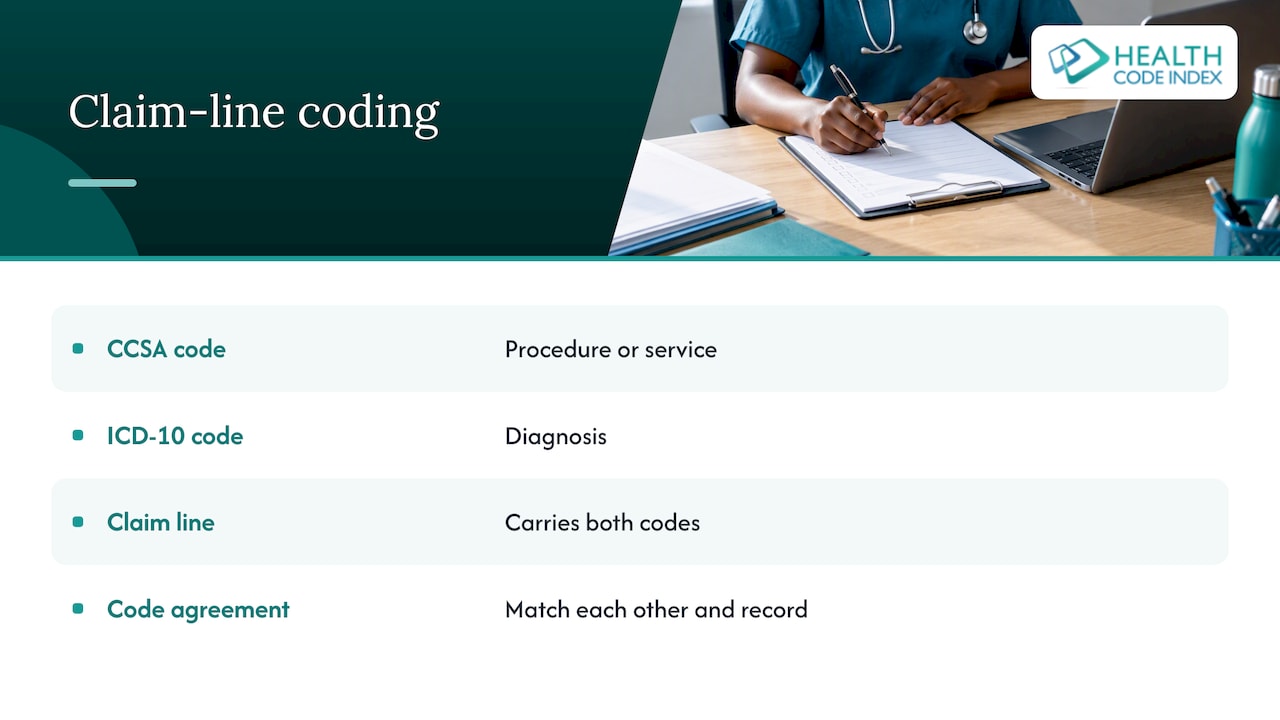
Second, the CCSA describes the service, not the diagnosis. The diagnosis is expressed in ICD-10. A claim line therefore carries at least two kinds of coded information that must agree with each other and with the clinical record.
How CCSA sits alongside ICD-10 and RPL
The SASCI coding guideline review for 2026 describes three main coding schemes in South Africa that pertain to medical doctors, and ICD-10 and the CCSA are two of them. Practice administrators will also be familiar with RPL, the reference price list that appears on many practice and funder tariff schedules.
| Element | What it describes | Typical question it answers |
|---|---|---|
| ICD-10 | The diagnosis or condition | Why was the patient treated? |
| CCSA (CPT® for South Africa) | The procedure or service | What was done? |
| RPL | A tariff structure used on practice and funder schedules | What is the reference price for this item? |
The three must tell one consistent story. A procedure code that has no plausible link to the diagnosis on the same claim line is the kind of mismatch that draws a query. We deal with the diagnosis side in more detail in our article on checking ICD-10 flags before claims are submitted.
What the PHISC CCSA guidelines are, and what they are not
Most readers searching for CCSA coding guidelines are looking for the document published by the CCSA Technical Workgroup of the PHISC Clinical Coding subcommittee. The current edition is Version 12, dated October 2025. Its stated purpose is to define standards and guidelines for interpreting the CCSA / CPT® coding structure for data purposes.
The distinction matters. The document is explicit that it applies to coding for data and not for billing. In practice that means:
- The PHISC guidelines support consistent data. Their primary role is to give accurate, consistent data for healthcare communication and continuity of care.
- Billing rules come from elsewhere. Individual funders and contractual agreements define how a service is billed. A code that is correct under the data standard may still be assessed differently under a scheme’s own rules.
- Both layers need to be checked. A billing office that treats the PHISC document as a billing manual will eventually meet a rejection it cannot explain.
The document is structured around general principles of CCSA coding and section-specific standards. The workgroup adds to it as decisions are taken at subcommittee meetings, so the version you hold is worth confirming at the start of every financial year.
The licensing point for trainers
The PHISC workgroup also states that anyone facilitating CCSA training must conform to SAMA’s copyright review requirements. If you commission in-house or external training for your coders, ask the provider how their material meets that requirement. It protects your organisation as well as the trainer.
Annual updates and the transition periods
The PHISC workgroup notes that coding standards must be updated annually, which fits the yearly cycle of the CCSA itself. For a practice manager the practical question is not whether a change is coming but when each part of the practice must be ready.
The PHISC document sets a three-month period for implementing operational changes and a six-month period for system-related changes after the guidelines are updated. The sensible reading is that two separate tasks follow every update:
- Operational: staff must learn what changed and apply it in daily coding and documentation.
- System: your practice management or hospital information system must carry the new code set and any new edits.
The two periods differ because software changes usually take longer to schedule, test and release than a briefing to staff. Plan both from the date the update is published, and name an owner for each.
A simple update calendar
| When | Action | Owner |
|---|---|---|
| Start of year | Confirm the current CCSA edition and PHISC guideline version in use | Practice or billing manager |
| Within the operational window | Brief coders and clinicians on changes that affect your common procedures | Senior coder or case manager |
| Within the system window | Confirm your billing system carries the updated code set | IT lead or system vendor contact |
| Quarterly | Review rejected and queried claims for recurring code problems | Billing manager |
Where CCSA coding errors usually begin
The PHISC workgroup is direct on this point: accurate documentation in the medical record is the non-negotiable foundation of coding accuracy. A coder can only assign what the record supports.
That has a management consequence. Coding problems that look like billing-office errors often start in the consulting room or theatre:
- Incomplete procedure notes. If the note does not describe what was done, the coder must guess or query.
- Late documentation. Notes written days afterwards tend to lose detail that determines the code.
- Unlisted procedures. The PHISC guidelines give general principles for unlisted procedures or services, which signals that this area needs particular care and a clear description.
- Diagnosis and procedure mismatch. The ICD-10 code and the CCSA code are captured by different people, or at different times.
A short feedback loop between coders and clinicians usually does more for accuracy than any change in software. Software helps most once the record is sound.
A working process for CCSA coding
This is the sequence we suggest for practices and hospital billing offices. It is deliberately simple, because a process that staff follow consistently beats a sophisticated one they skip.
- Confirm the code set. Check that everyone is using the current CCSA edition and the current PHISC guidelines version.
- Code from the record. Assign the CCSA and ICD-10 codes from documented care, not from habit or from a previous claim for the same patient.
- Validate at capture. Check each code for validity and for consistency with the diagnosis before the claim leaves your system. Catching a problem at capture is cheaper than a rejection weeks later.
- Apply funder rules. Check the scheme’s billing rules and your contractual agreements, remembering that the data standard does not cover billing.
- Review the exceptions. Look at rejected or queried claims every month and trace each to its cause: documentation, code selection, or funder rule.
- Retrain on the pattern. Use what the exceptions show to focus your next training session.
For hospitals, steps three and four carry the most volume. For medical schemes, the same chain works in reverse: reliable coding data at intake is what allows coverage to be determined consistently.
Training your coding team
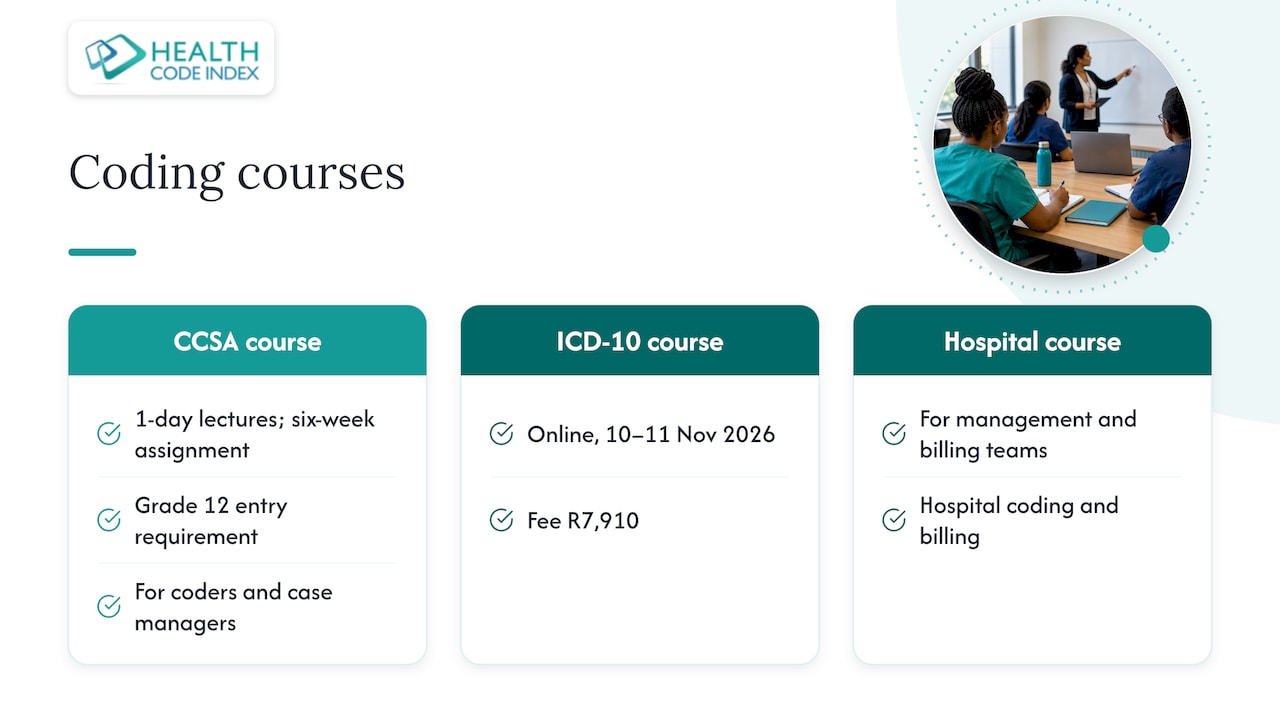
Professional clinical coding roles are in demand across the public and private sectors, and training is available locally. The University of Cape Town’s Continuing Education Unit runs a basic training course in the CCSA. It is aimed at clinical coders and case managers, and at people seeking a career in either field. The course combines one day of lectures with a six-week distance learning assignment, and the entry requirement is a Grade 12 certificate.
On the diagnosis side, the same unit offers basic training in ICD-10 coding. The course dated 10 to 11 November 2026 is presented online via Microsoft Teams, at a course fee of R 7 910. Fees and dates change, so confirm them on the course page before you budget.
For management and billing teams, there is also a hospital coding and billing course aimed at management, case managers, credit controllers, auditors and billing and pre-authorisation clerks in a hospital environment.
Training is most useful when it is paired with a way to check the result. A coder who has completed a course still benefits from validation at the point of capture, particularly in the first months after a code set update.
Our perspective
We built Health Code Index around a problem we see repeatedly: coding rules sit in several places. The code set sits in one document, the data guidelines in another, and the billing rules in each funder’s own requirements. A busy billing office is expected to hold all of that in mind for every claim.
Our view is that the answer is not to ask staff to memorise more. It is to put reliable code search, validation and compliance checks where the work is done, and to keep them current. That is why the platform covers CPT-4/CCSA and ICD-10 code search and validation, and why rule and code updates are managed externally rather than left to each practice to track. Lumina AI also lets users look up clinical codes using natural language, which helps when a coder knows the clinical description but not the code.
We also hold to the distinction that the PHISC guidelines draw. Data standards and billing rules are different things, and a good process respects both. Technology supports a coder’s judgement, and it does not replace the clinical record that judgement depends on.
— Lumina
How Health Code Index supports CCSA coding
If you are reviewing how your organisation handles CCSA and ICD-10 coding, our service overview describes three areas: clinical code search, claims processing and claims compliance. Our platform covers CPT-4/CCSA, ICD-10 and RPL codes, with PMB indicators among the compliance checks.
The right entry point depends on your role:
- Hospitals and provider networks can see how we approach faster, cleaner claims on our hospitals and provider networks page.
- Medical schemes and insurers can read about reliable coding data on our medical schemes and insurers page.
- IT and integration teams can review clinical coding API and HIS integration, which is designed to work with existing billing and practice management systems.
Pricing is arranged according to your needs and level of integration, so please contact us through the Health Code Index website to discuss what suits your organisation.
Frequently asked questions
What is the difference between CCSA and CPT-4?
CPT is the American Medical Association’s coding system for medical procedures and services. The CCSA is the South African version, licensed to SAMA by the AMA, and it is used in the local healthcare sector. In everyday practice many people write CPT-4/CCSA to refer to the same procedural code family.
Do the PHISC CCSA guidelines tell me how to bill?
No. The PHISC document states that it applies to coding for data and not for billing. Billing rules are set by individual funders and contractual agreements, so your billing process must check those separately.
How often does CCSA coding change?
The PHISC workgroup states that coding standards must be updated annually, and the 2026 SAMA electronic edition took effect on 1 January 2026. The PHISC document allows three months to implement operational changes and six months for system-related changes. Confirm the dates for each update against the published guidelines.
What qualifications do I need to work as a clinical coder?
The UCT basic CCSA course lists a Grade 12 certificate as the entry requirement, and it suits those seeking a career in clinical coding or case management. Employers set their own requirements for roles, so check the specific job description. Further certifications are available for those who want to specialise.
Sources
- PHISC CCSA Coding Standards and Guidelines, Version 12 (October 2025)
- SAMA eStore: eCCSA 2026
- SASCI Coding Guideline Review for 2026
- UCT: Basic Training in Complete Current Procedural Terminology for South Africa
- UCT: Basic Training in ICD-10 Coding
- UCT: Hospital Coding and Billing