
Accurate ICD-10 coding depends on using WHO ICD-10 volumes together with the South African ICD-10 Master Industry Table and the National Morbidity Coding Standards. The immediate action for any coder or practice administrator is to sequence primary and secondary diagnoses correctly, submit codes in the MIT-approved format, and keep practice management systems synchronised to the current MIT release to avoid automated claim rejections.
Key Takeaways
Accurate ICD-10 coding in South Africa requires strict adherence to local standards, correct sequence, format, and validation using the latest MIT release for claims success.
| Point | Details |
|---|---|
| Follow a consistent coding sequence | Use the alphabetic index first, then confirm codes in the tabular list before finalising. |
| Verify code validity | Check the MIT validation flags for clinical use and primary eligibility before coding and submitting. |
| Apply correct formatting rules | Capture codes without spaces or hyphens, with a dot after the third character for four- or five-character codes. |
| Ensure accurate sequencing | Sequence primary and secondary diagnoses correctly based on coding standards to avoid claim rejection. |
| Utilise current MIT releases and updates | Download and compare MIT version dates regularly, and test updates before implementing in practice management systems. |
Table of Contents
-
ICD-10 quick checklist: essential rules every coder must apply
-
Sequencing rules: primary diagnosis, secondary diagnoses and claims impact
-
Keeping your code set current: updates and implementation windows
-
How Health Code Index supports accurate coding and faster reimbursement
ICD-10 quick checklist: essential rules every coder must apply
Before assigning any diagnosis code, work through the same sequence every time. Consistency at this stage can help reduce avoidable errors in claims processing.
-
Consult the Alphabetical Index first, then confirm the code in the Tabular List before finalising it.
-
Review the relevant inclusion terms and tabular-list guidance when checking a candidate code.
-
Check the MIT validity flags, Valid_ICD10_ClinicalUse and Valid_ICD10_Primary, to confirm a code can be used and whether it qualifies for the primary position.
-
Format codes without spaces or hyphens, placing a dot after the third character for four or five character codes.
-
Apply dagger and asterisk conventions where the classification and applicable South African standards call for them.
-
Review relevant coding guidance and system checks, and consult the applicable standards when considering external cause codes.
Pro Tip: Check new or unfamiliar codes against the MIT validity flags before saving a claim; the flags indicate whether a code is valid for clinical use and the primary position.
This sequence matters because each source serves a different purpose. The index helps identify a code, the tabular list supports code selection, and the MIT flags indicate whether a code is valid for clinical use or the primary position. Skipping the MIT check is one of the most common reasons a technically correct ICD-10 code still gets rejected at claims level, since clinical accuracy and administrative validity are governed by separate rule sets.
ICD-10 code structure and conventions explained
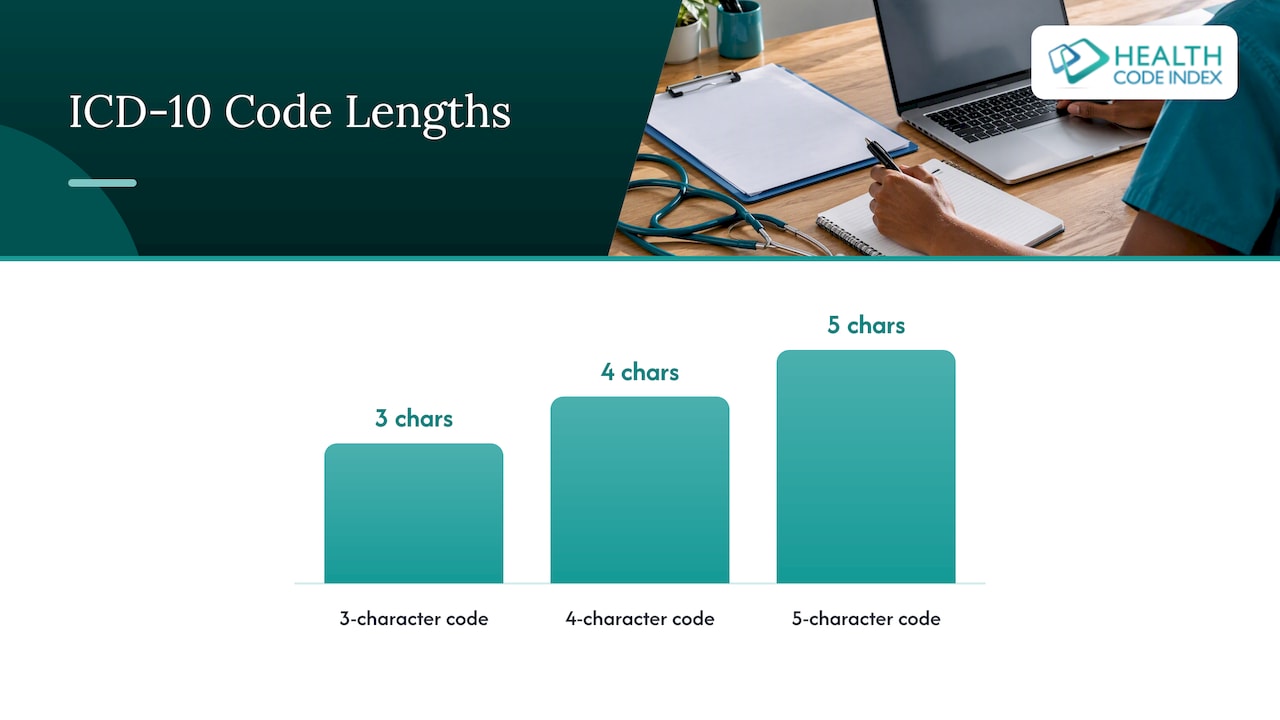
ICD-10 codes are built from three, four or five characters, and the character count is not cosmetic: it reflects how specific the diagnosis needs to be. A code’s characters represent its classification detail. Where a code has a fourth or fifth character, follow the applicable format and consult the index and tabular list to determine the correct code.
Formatting rules are strict and mechanical rather than a matter of style. WHO guidance and the South African technical standards both require codes to be captured without spaces or hyphens, with the decimal point appearing after the third character whenever a fourth or fifth character is present. Follow the prescribed format when capturing a code, and check the relevant system guidance if a code is rejected.
The South African technical guide allows an x or X placeholder in specified codes. Check the applicable code and guidance rather than leaving a required placeholder position blank.
The standards include dagger and asterisk conventions. Consult the applicable coding guidance to determine whether both codes are needed and how they should be sequenced.
Check the applicable dagger and asterisk convention and the prescribed code format before submitting a claim.
Common pitfalls worth checking before submission:
-
A missing decimal point on a code that requires one.
-
An ‘X’ placeholder omitted where the category structure calls for it.
-
A dagger code submitted without its paired asterisk code, or the reverse.
-
A code copied from an older reference that predates the current MIT revision.
Sequencing rules: primary diagnosis, secondary diagnoses and claims impact
Sequencing is an important part of applying the South African coding standards and preparing claims.
The National Morbidity Coding Standards include GSN0001 on primary diagnosis. Consult the standard for its requirements. Apply the primary-diagnosis guidance when selecting and sequencing codes, and consult the standard where the correct order is unclear.
The standards include GSN0002 on secondary diagnoses. Consult it when applying secondary-diagnosis rules. Apply the relevant standards when recording secondary diagnoses and sequencing them relative to the primary diagnosis.
A few sequencing points apply consistently across scenarios:
-
Check the MIT’s Valid_ICD10_Primary flag to determine whether a code is valid in the primary position.
-
Apply the applicable standards when sequencing secondary diagnoses relative to the primary diagnosis.
-
Consult the applicable guidance when coding sequelae.
-
Follow the applicable coding and claims guidance when recording diagnoses relevant to Prescribed Minimum Benefit entitlements.
Treating sequencing as an afterthought once the “right” codes have been identified is a mistake. The order and position of codes on a claim carry as much administrative weight as the codes themselves.
Common real-world coding scenarios with worked examples
Worked examples make the abstract rules concrete. The scenarios below reflect the kind of sequencing and selection decisions coders face routinely.
-
Diabetes with a complication. Where a patient presents with Type 2 diabetes complicated by diabetic nephropathy, the diabetes code with the renal complication is typically the primary diagnosis, since it reflects the condition responsible for the complication being treated. The applicable classification and sequencing guidance determine whether another code is needed and how the codes should be ordered.
-
Acute presentation on a chronic background. For a patient with chronic hypertension and an acute presentation, consult the classification and applicable standards to determine the correct codes and sequencing for the episode. Ensure code selection reflects the documented clinical circumstances, following the applicable coding guidance.
-
Injury with an external cause. For an injury, consult the applicable coding guidance to determine whether an external cause code is required. Check the applicable standards to determine whether an external cause code is needed for the case.
-
Sequelae of a prior condition. For a patient presenting with a possible late effect of a prior stroke, consult the applicable classification and standards to determine the correct coding. Consult the National Morbidity Coding Standards and applicable ICD-10 guidance when coding late effects.
Each of these scenarios shares a pattern: the correct code is rarely in doubt, but its position, pairing with a second code, or distinction from a similar-looking alternative is where accuracy is won or lost.
Claim submission and formatting rules to avoid rejections
Getting the code right clinically is only half the task. PHISC guidance and the technical standards also govern how codes must be captured and transmitted on a claim, whether paper or electronic.
The South African standards include GSN0101 on mandatory inclusion of ICD-10 codes on claims and provisions on paper and electronic claims. Consult the applicable rules for claim requirements. Check that the code is captured in the required format and that the claim follows the applicable submission requirements.
Practical points worth building into day-to-day practice:
-
Check that your practice management system supports ICD-10 code capture in the format required for claims.
-
Check that codes with four or five characters are captured with the required dot after the third character.
-
Verify primary and secondary diagnosis fields are mapped to the correct claim positions before going live with any new system or update.
-
Where a claim is rejected, check the MIT validity flags for the submitted code before assuming the clinical coding itself was wrong.
Pro Tip: When a batch of claims comes back with the same rejection code, check the MIT flags for the diagnosis code involved before troubleshooting the practice management system itself; a stale MIT file is a more common cause than a software fault.
Most rejection patterns trace back to one of two causes: a formatting error introduced at capture, or a code that has since been superseded in a newer MIT release. Distinguishing between the two early saves considerable administrative time.
Keeping your code set current: updates and implementation windows
The MIT is not static. It incorporates WHO corrigenda and local revisions, and it is distributed in CSV and XLS formats specifically so it can be imported into billing software without manual re-keying.
South African guidance distinguishes between two kinds of update. Operational changes, such as a sequencing clarification, typically carry a shorter adjustment period, while system-related changes, such as a revised field structure, generally require a longer window to allow practice management vendors to implement and test the change. Treating every update as urgent, or ignoring version dates entirely, both carry risk.
Practical maintenance steps for any practice or hospital coding team:
-
Download the current MIT release and compare its version date against the file your system is currently using.
-
Test imported updates in a staging environment before pushing them to the live billing system.
-
Document each implementation, including the date applied and the MIT version number, for audit purposes.
-
Subscribe to Task Team circulars, or contact the Task Team directly at ICD10@health.gov.za, to be notified when a new release is published.
A practice running an outdated MIT file will often see valid clinical coding rejected simply because the code’s status changed in a version the billing system never received.
Quick reference: where to find the official documents
Keeping the primary sources bookmarked saves time when a coding question arises mid-claim.
-
WHO ICD-10 Volume 2 for the classification structure, tabular list and inclusion rules.
-
The South African ICD-10 Technical User Guide for MIT field definitions and validity flags.
-
The National Morbidity Coding Standards and Guidelines for GSN sequencing and claim inclusion rules.
-
The National Department of Health website for the current MIT download and Task Team circulars.
Formal coding training, combined with regular practice against real claim scenarios, remains the most reliable way to build and maintain competency, since the standards themselves assume a working familiarity with both the WHO framework and the local GSN provisions rather than treating either as self-explanatory.
How we think about applying these rules day to day
“We see that the gap between correct coding and accepted claims is often less about clinical knowledge and more about keeping systems aligned to the current MIT release and catching sequencing errors before a claim leaves the building. When validation happens automatically at the point of capture rather than after a rejection comes back, coders spend less time on manual edits and more time on the cases that genuinely need clinical judgement.” said Mr. Willem Uys, Global Group Executive at SpesNet Group.
Asked to elaborate on how Health Code Index enables clinical coding and automates the data validation he continued “The greatest efficiency & speed enhancements are seen by clients that integrate validation directly into their existing workflow rather than treating it as a separate compliance step. The clinical coding intelligence and real-time updates we embed are not optional reading for a coding team; they are the working reference, and the smoother a system makes them to apply, the fewer claims bounce back for reasons that had nothing to do with clinical accuracy.”
— Willem Uys. Global Group Executive, Business Operations. SpesNet Group
How Health Code Index supports accurate coding and faster reimbursement
We built our Healthcare Clinical Code Search, Claims Processing and Claims Compliance services to put the rules covered in this guide directly into your coding workflow rather than leaving them in a reference document on a shelf. Our code search and validation tools check ICD-10 codes against current MIT flags in real time, and our API and HIS integration keep validation synchronised with your existing practice management or hospital information system as updates are released.
This is built for the teams carrying day-to-day coding and claims accountability:
-
Hospitals managing claims across their departments.
-
Medical schemes needing consistent compliance checks across submitted claims.
-
Claims administrators who need code validation built into their existing systems rather than run as a separate manual step.
Visit our service overview to see how code search, validation and compliance checking fit into your current claims process.
FAQ
What are the updated ICD-10-CM guidelines for the current year?
ICD-10 guidance is updated through the South African Master Industry Table and the National Morbidity Coding Standards, both maintained by the ICD-10 National Task Team, rather than through a single annual release. WHO’s ICD-11 2026 release also notes that ICD-11 integrates with health systems through APIs and mappings, which is relevant for practices planning a future transition. For current ICD-10 coding, always check the MIT version date against your billing system before relying on a new rule.
Where can I find a list of valid ICD-10 codes?
The authoritative list for South African use is the Master Industry Table, available from the National Department of Health alongside the Technical User Guide that explains its fields. The WHO ICD-10 volumes provide the full international classification, Alphabetical Index and Tabular List that the MIT draws from.
How do I correctly assign an ICD-10 code to a diagnosis?
Start with the Alphabetical Index to identify candidate codes, then confirm the selection in the Tabular List, checking inclusion and exclusion notes along the way. Once a code is selected, verify it against the MIT validity flags to confirm it is valid for clinical use and eligible for the position, primary or secondary, you intend to assign it.
What codes are used to describe a patient’s diagnosis on a claim?
A claim typically carries a primary diagnosis code, selected under the GSN0001 rules for the condition chiefly responsible for the episode, along with secondary diagnosis codes for relevant comorbidities. External cause codes and, where applicable, sequelae codes may also be required depending on the clinical scenario.
Sources
Three categories of document carry weight in ICD-10 coding, and each plays a distinct role. Treating one as a substitute for another is where most coding disputes originate.
WHO ICD-10 Volume 2 confirms the structure of the classification: three volumes covering the tabular classification, instructions and guidance, and the alphabetical index, with explicit direction to consult both the Alphabetical Index and the Tabular List before a code is assigned. It provides the international classification framework, including the tabular list and its inclusion terms.
The South African ICD-10 Technical User Guide describes the Master Industry Table as the industry standard in South Africa. The MIT includes fields such as Valid_ICD10_ClinicalUse and Valid_ICD10_Primary, which indicate whether a code is valid for clinical use and whether it can be used in the primary position. It is distributed in XLS and CSV formats for import.
The National Morbidity Coding Standards and Guidelines, maintained by the ICD-10 National Task Team, layer local conventions on top of the WHO framework. These standards set out local guidance, including GSN0001 on primary diagnosis and GSN0101 on mandatory inclusion of ICD-10 codes on claims.
In practice, the three sources work together rather than interchangeably:
-
International statistical classification of diseases and related health problems
-
Developed to assist the Clinical Coder in the South African environment Date: April 2014
When interpretation is genuinely unclear, such as a borderline inclusion note or a sequencing question the GSNs do not directly address, escalate through the channels the guidance itself points to rather than guessing. For unresolved interpretation questions, consult the relevant guidance or seek clarification through appropriate channels rather than treating an ambiguous call as settled policy.