
A sound coding audit checklist confirms five things: correct code set and version, documentation that supports the codes billed, accurate code assignment and sequencing, correct modifier and bundling use, and a defensible sampling method. Before any file review begins, we recommend setting a clear scope and pulling an initial sample, so findings stand up to scrutiny from coders, clinicians and payers alike.
Key Takeaways
A comprehensive coding audit checklist ensures reimbursement accuracy and compliance by mapping every critical domain from code validation to claims reconciliation, supported by automated validation tools.
| Point | Details |
|---|---|
| Code set and version compliance | Ensure the correct and current coding sets are used at the time of service to prevent outdated coding errors. |
| Documentation adequacy | Verify clinical notes support the billed codes with proper dates, signatures, and clinical detail. |
| Claims reconciliation accuracy | Match all claim details such as units, dates, and authorisations against the encounter records for consistency. |
| Use of validation tools | Implement automated code search and validation platforms to streamline code verification and reduce manual effort. |
| Health Code Index integration | We recommend Health Code Index to facilitate real-time code validation, claims reconciliation, and consistent review processes. |
Table of Contents
Essential domains to include in every coding audit checklist
A coding audit checklist works only when it maps every domain that touches reimbursement accuracy and compliance risk. Miss one, and the audit leaves a gap that a payer, regulator or internal review will eventually find.
Each domain below deserves its own line of enquiry during a review, not a single tick-box:
-
Code set and version compliance: confirm the correct ICD-10, CPT/CCSA or RPL code set and version was applied at the time of service.
-
Documentation adequacy: check that dates, provider signatures and clinical detail genuinely support the level of code billed.
-
Code assignment and sequencing: verify primary versus secondary diagnosis order and that procedure codes link logically to the documented diagnosis.
-
Modifier accuracy and payer rules: test modifier use against medical necessity and bundling edits.
-
Claim-level reconciliation: match units, service dates, authorisations and timely filing against the underlying encounter record.
These domains rarely sit in isolation. A documentation gap often produces a sequencing error downstream, and a modifier mistake can mask a bundling violation that only surfaces once claims are reconciled against encounter data. Treating the checklist as five connected checks, rather than five separate boxes, gives auditors a clearer line from clinical note to paid claim.
Itemised checklist: practical record-by-record checks
Once scope and sample are set, the real audit happens record by record. The following sequence gives auditors a consistent, repeatable path through each file.
-
Confirm code set and version. Flag any code drawn from an outdated ICD-10, CPT/CCSA or RPL release.
-
Check coding guideline application. Verify that official sequencing and coding conventions, not local habit, drove the code choice.
-
Review documentation support. Look for provider identity, date and time stamps, a signature, and clinical detail proportionate to the code billed.
-
Validate evidence of decision-making. Clinical notes should show the reasoning behind a diagnosis or procedure, not just the conclusion.
-
Test E/M level justification. Match the billed evaluation and management level against documented history, examination and medical decision-making.
-
Link procedure codes to documentation. Every procedure code needs a corresponding note describing the service performed.
-
Flag crosswalk mismatches. Watch for diagnosis-procedure pairs that do not logically correspond.
-
Verify modifier use. Confirm modifiers reflect genuine clinical circumstances, not a default habit to bypass bundling edits.
-
Check payer-specific exceptions. Some payers apply bundling or modifier rules that differ from general coding guidance.
-
Confirm global period awareness. Procedures within a global surgical period need separate justification if billed again.
-
Match units and quantities. Billed units must equal what the documentation supports.
-
Verify service dates. Dates on the claim should match the encounter record exactly.
-
Confirm prior authorisations. Where required, authorisation numbers should appear on both the claim and the clinical file.
-
Check for duplicate claims. Cross-reference claim history to catch accidental resubmissions.
Pro Tip: Keep a standing log of crosswalk mismatches you find across audits. Recurring mismatches often point to a training gap rather than a one-off coder error.
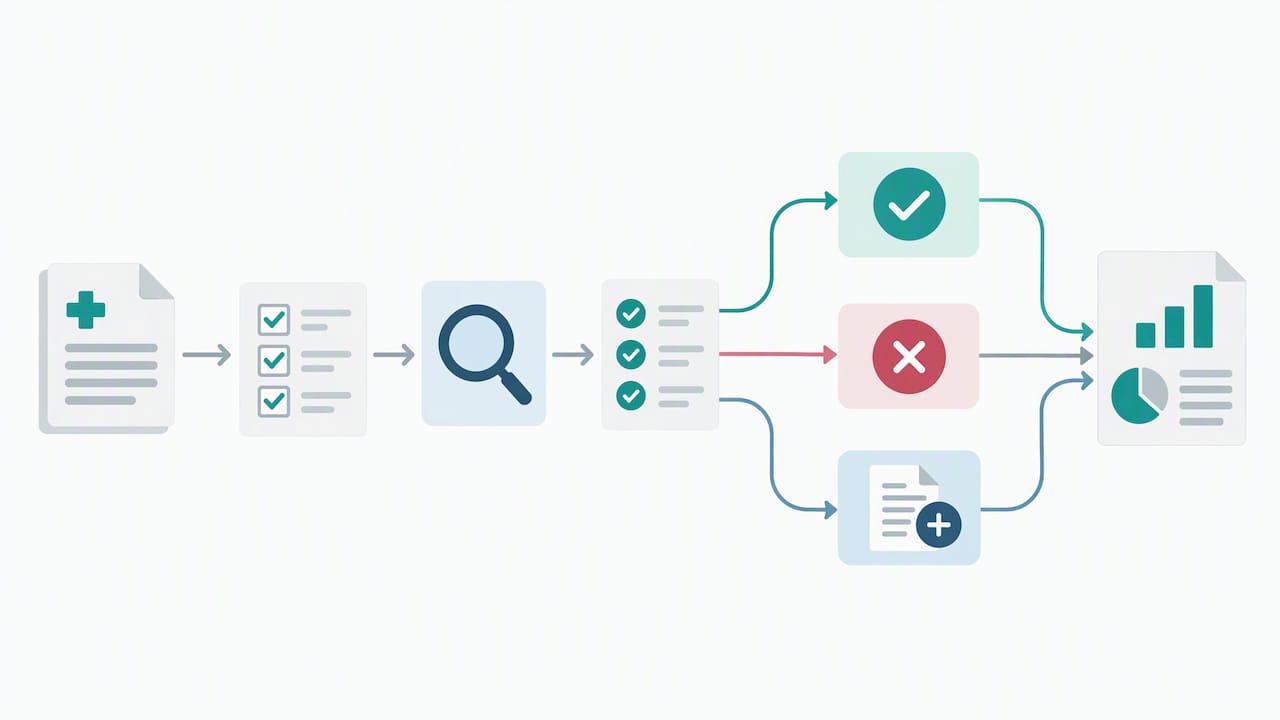
This sequence works equally well for a single high-risk file or a full quarterly batch, because each step produces a clear pass, fail or “evidence needed” result that feeds directly into the findings report.
Audit process: scope, sampling rules and sample expansion
A checklist only produces defensible results when the sampling method behind it is transparent and consistent.
-
Define scope and objectives first: decide whether the review covers a specialty, a single coder or a specific service line before pulling any files.
-
Apply a baseline cadence of quarterly reviews, with an internal audit best-practice guidance suggesting a minimum initial sample of three records per provider for E/M services.
-
Use random sampling for routine monitoring and targeted sampling for high-value codes, recent denials or newly changed policies, since a practical audit checklist recommends balancing the two approaches.
-
Expand the sample whenever error rates exceed an agreed threshold, and document the expansion rule in the final report so reviewers understand why the sample size changed.
Recording the sampling methodology alongside the findings matters as much as the findings themselves: a reviewer who cannot see how records were chosen cannot judge whether the result represents the broader coding pattern.
Recording findings, corrective actions and verification
Findings only create value once they are written down in a form someone can act on and someone else can verify.
-
Use a standard finding template that captures severity, supporting evidence, financial or compliance impact, a recommended fix, an assignee and a due date.
-
Communicate findings to clinicians through a structured written report rather than an informal conversation, since verbal feedback leaves no audit trail.
-
Link each corrective action to a measurable target, such as a reduced error rate on the next review, and schedule a re-review window to confirm the fix held.
-
Close the loop by retesting the corrected items and recording verification evidence, such as a corrected claim resubmission, in the audit log rather than relying on a coder’s assurance that the issue is fixed.
Pro Tip: Treat every closed finding as unverified until you see evidence of the correction in the next sample, not just a confirmation that training took place.
Operationalising the checklist with code validation tools
Running this checklist manually across hundreds of records consumes significant auditor time, particularly the code set and version checks that repeat on every single file. A code search and validation platform such as Health Code Index addresses that specific bottleneck.
-
Real-time code search and validation removes the need to manually cross-check ICD-10 and CPT-4/CCSA code versions against a printed or outdated reference list.
-
Batch validation lets a reviewer check a full sample of claims against current code sets in one pass rather than file by file.
-
API integration with existing practice management and hospital information systems allows auditors to reconcile billed codes against clinical notes without re-keying data between systems.
For audit teams who want to see how these workflows apply to their own claims volume, our service overview sets out how code search and validation fit into a standing compliance programme.
Prioritisation and measuring audit programme value
The checklist itself matters less than where we aim it. High-risk codes, high-volume services and anything touched by a recent policy change deserve first attention, because that is where error rates and financial exposure concentrate.
Track a small set of KPIs consistently: coder error rate by domain, financial impact per finding, and time-to-close from finding to verified correction. A multidisciplinary review team, including a clinical voice alongside the coder, reduces disagreement rates on documentation adequacy, since clinical concordance checks are ultimately a judgement about the reality of care delivered, not just the code on the page. The checklist itself should be a living document: codes and payer rules change every year, and a checklist that is not revisited drifts out of date quietly.
Put the checklist into practice with Health Code Index
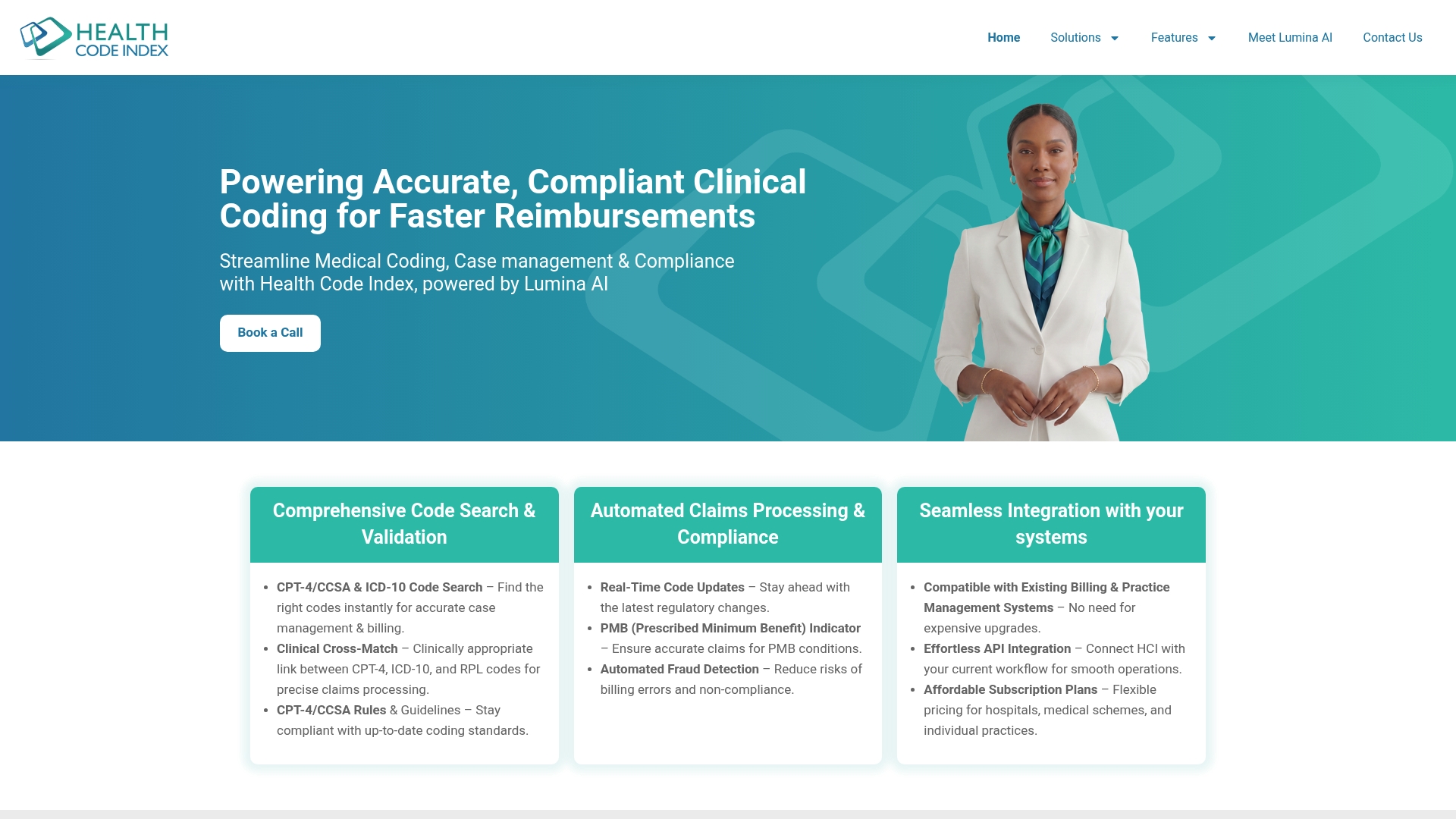
Every domain on this checklist, from code set validation to modifier accuracy to claims reconciliation, becomes faster and more consistent when the lookup work is automated rather than manual.
-
Search and validate ICD-10, CPT-4/CCSA and RPL codes in real time, without switching between reference books and claims systems.
-
Reconcile billed codes against clinical documentation through API integration with your existing practice management or hospital information system.
-
Apply the same current rule set across every reviewer, reducing the version-mismatch findings that eat into audit time.
Visit our service overview to see how code search, claims processing and compliance checks fit into your next audit cycle, or explore solutions for hospitals and provider networks built around exactly this kind of review workload.
FAQ
What is a coding audit?
A coding audit is a structured review of clinical records and billed codes to confirm that the codes assigned match the documentation and comply with current coding and payer rules. It typically checks code accuracy, sequencing, modifier use and claim-level details such as units and authorisations.
What are the 5 C’s of audit?
Definitions of the “5 C’s” vary by organisation and context, so there is no single universal version for clinical coding audits. In general use across audit disciplines, the term usually refers to criteria such as condition, criteria, cause, consequence and corrective action applied to each finding.
What are some good checklists for code review?
A strong code review checklist groups items by domain, such as security, architecture, documentation and testing, rather than listing checks in random order. The SystemAudit practical checklist sets out a five-area structure covering security, architecture, dependencies, testing and documentation that translates well to clinical coding review.
What are the 7 steps in the audit process?
Audit methodologies differ across industries, so there is no single fixed seven-step sequence that applies universally. A typical clinical coding audit generally follows scope definition, sample selection, record review, finding documentation, reporting, corrective action and verification through re-review.