A CPT-4 modifier is a two-character addition to a procedure code that tells the payer something about how the service was performed, without changing what the code means. In South Africa there is a practical twist: the CCSA standard stores modifiers as five-digit codes in the 099xx range, so “modifier 59” on an international chart becomes 09959 in your data. This guide explains what the common modifiers do, how 59, 51 and 25 differ, what the local rules change, and how to keep claims defensible.
It is written for practice managers, billing administrators, hospital revenue teams and scheme analysts who need to get modifier use right and consistent.
Key takeaways
- CCSA modifiers are agreed to be presented and stored as five-digit codes (099xx), not as the two-digit suffix used in international CPT-4 material. Your billing system must recognise that format.
- Modifier 59 (09959) marks a distinct procedural service, modifier 25 marks a separately identifiable evaluation and management (E/M) service, and modifier 51 concerns multiple procedures. They answer different questions and are not interchangeable.
- Modifiers must be supported by clinical documentation. They represent what happened; they are not a way to lift payment.
- Medical scheme rules and society guidelines can override the international reading of a modifier, so check the local manual before you submit.
Table of Contents
- What a CPT-4 modifier does
- The five-digit CCSA format used in South Africa
- Common modifiers at a glance
- Modifier 59 vs 51 vs 25
- Why South African rules change the answer
- Documentation that supports a modifier
- When a claim is bundled or downcoded
- Our perspective
- How Health Code Index fits into this
- A practical routine for your billing team
- FAQ
- Sources
What a CPT-4 modifier does
CPT-4 codes describe a procedure or service. A modifier adds context: the work was bilateral, increased, reduced, repeated, performed by a different clinician, or separate from another service on the same day. Novitas Solutions describes modifiers as indicating that a service was altered by a specific circumstance but not changed in its definition or code.
That definition matters for how you use them. A modifier does not create a new service. It explains an existing one, so the claim and the clinical record have to tell the same story.
The five-digit CCSA format used in South Africa
In the Complete CPT for South Africa (CCSA) environment, modifiers can be presented and stored either as a five-digit code (099xx) or as a suffix to the procedure code, and the agreed standard is the five-digit code. So the international “-50” is stored as a 099xx value, and “-59” appears as 09959.
The practical consequences for a practice or hospital:
- Confirm that your practice management or hospital information system accepts and outputs 099xx values.
- Check that anything mapping international charts to local codes translates the suffix correctly.
- Test a sample of claims before a rule change goes live, not after the first batch of rejections.
The PHISC guidance also states that modifiers must always follow the procedure code they modify. It sets no required sequence when several apply to one code, but they should be listed individually, rather than replaced with a catch-all such as 09999. Under that version, modifiers are used for information in the data environment unless a contract says otherwise.
One more point: the same document notes that practitioners should refer to the latest CCSA modifier spreadsheet for authorised modifiers. Some AMA-defined modifiers, such as certain place-of-service or anaesthesia physical status modifiers, may not apply under local funder agreements.
Common modifiers at a glance
The table lists modifiers that come up most often in the international CPT-4 set, which the American Academy of Family Physicians also lists in its 2026 guidance on modifier use. Before you use any of them locally, confirm that it is authorised in the current CCSA modifier list and accepted by the funder.
| International modifier | Meaning | Typical question it answers |
|---|---|---|
| 22 | Increased procedural services | Was the work substantially greater than usual? |
| 25 | Significant, separately identifiable E/M service on the same day as a procedure | Was there a consultation distinct from the procedure’s routine pre-work? |
| 26 | Professional component only | Did the clinician only interpret or supervise? |
| 50 | Bilateral procedure | Was the same procedure done on both sides? |
| 51 | Multiple procedures | Were several procedures performed in the same session? |
| 59 (CCSA 09959) | Distinct procedural service | Were two procedures genuinely separate? |
| 76 | Repeat procedure, same clinician | Was the procedure repeated on the same day? |
The PHISC document describes modifier 22 as indicating increased procedural services and modifier 25 as a significant, separately identifiable E/M service on the same day as a procedure.
Modifier 59 vs 51 vs 25
These three are confused because all three show up when more than one thing happens on a single date of service. The distinction is simple once you ask what is being separated.
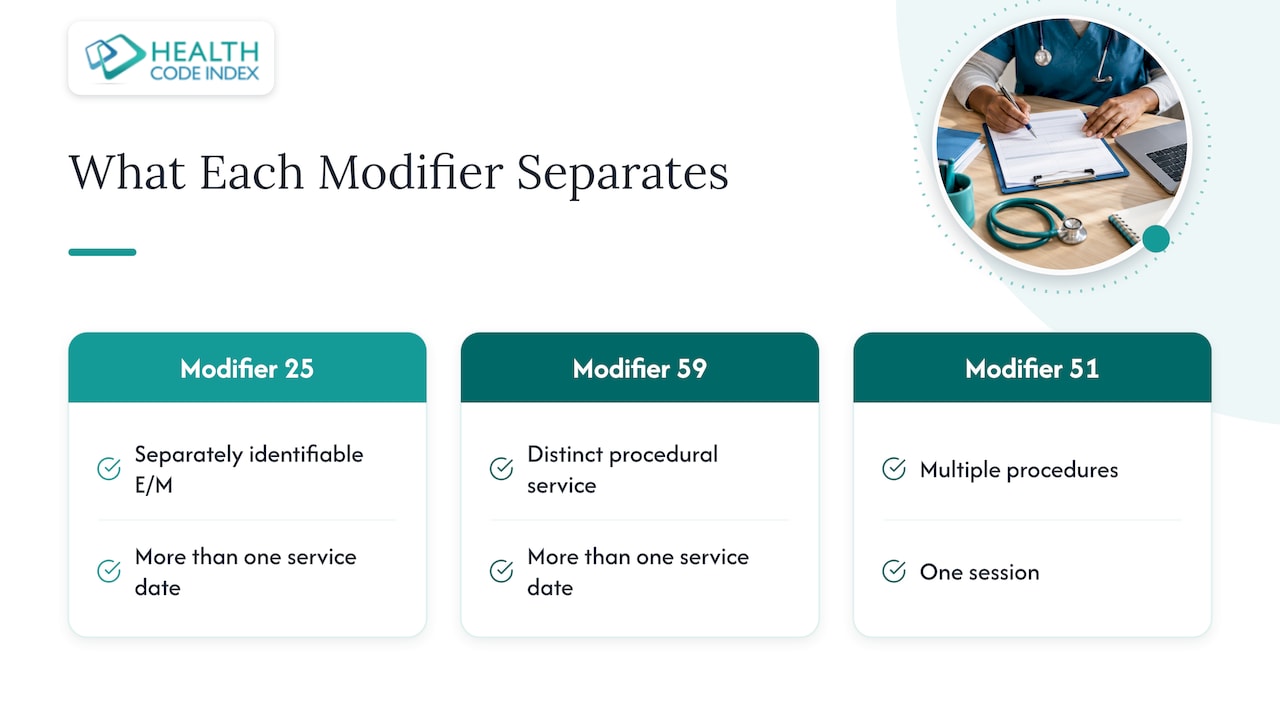
Modifier 25: two kinds of service
Modifier 25 sits on an E/M service, not on a procedure. It says that the consultation went beyond the routine assessment that belongs to the procedure. The US CMS National Correct Coding Initiative manual addresses appending modifier 25 to a significant, separately identifiable E/M service performed on the same date as a procedure. The AMA Council on Medical Service notes that modifier 25 is the one most commonly reported when multiple services are billed.
Example: a patient attends for a chronic condition review and, during the visit, a minor procedure is also needed for a separate problem. The review is documented as its own assessment and plan. The E/M carries the modifier; the procedure does not.
Modifier 59: two procedures that really are separate
Modifier 59, rendered 09959 in CCSA, identifies a distinct procedural service. You use it when two procedures that a payer would normally bundle were performed at different sessions, on different sites, or through separate incisions, and the record shows it.
PHISC gives a worked example: after a diagnostic laparoscopy, an open cholecystectomy was performed. The cholecystectomy is reported as the primary procedure and the laparoscopy as a secondary procedure carrying 09959, because the diagnostic work was distinct from the open operation.
When to use it, in practice:
- The two procedures were done at separate encounters on the same day.
- They were done on separate anatomical sites or organs.
- They involved separate incisions or excisions.
- The documentation says so in plain words.
When not to use it: if the only reason is that the claim was bundled and you want it paid. That is the pattern the AMA warns about. Modifiers are for accurate representation, not for lifting payment, and an unsupported 59 is a typical audit trigger.
Modifier 51: multiple procedures in one session
Modifier 51 tells the payer that several procedures were performed during the same session. Unlike 59, it does not argue that a bundle should be broken. It signals that multiple-procedure payment rules apply. In South Africa those rules are often expressed as percentages. For example, the SASCI coding guideline sets out that when multiple procedures are performed under the same anaesthetic and each is clearly identified, the second procedure attracts 75% of its value. Read the current guideline for the remaining steps and exceptions.
Choosing between them
| Situation | Modifier to consider |
|---|---|
| Consultation separate from the procedure’s routine work | 25 on the E/M |
| Two procedures that a payer might bundle, but are distinct | 59 (09959) |
| Several unrelated procedures in one operative session, normal multiple-procedure payment | 51 |
These are starting points. A scheme may apply its own logic, which leads to the next point.
Why South African rules change the answer
International CPT-4 guidance is a useful reference, but it is not the rulebook that decides your claim. SASCI’s guideline and the scheme-specific manuals describe local conventions. In South Africa, medical schemes frequently apply their own “rule” modifiers, such as Rule G for post-operative care, and these local rules can supersede the international reading. Practitioners are advised to consult the Medical Doctor Coding Manual or the relevant society guideline to limit audit risk and rejections.
Two further local points:
- Bilateral add-on codes. PHISC states that, from 1 January 2024, bilateral add-on codes are reported twice with 09959, and the use of 09950 for that purpose is no longer recommended. Check whether your templates still carry the old approach.
- Data versus billing. The PHISC standards apply to coding for data, not for billing. Your contract with each funder still decides what is payable.
Documentation that supports a modifier
The AMA’s guidance on multiple services identifies a recurring disconnect between providers and payers over the documentation needed to justify them. The remedy is to verify scheme policy in advance and to make sure the clinical record explicitly supports each modifier.
A short internal checklist helps:
- Does the note describe the reason the service was separate, in the clinician’s words?
- Are times, sites or sides recorded where relevant?
- Does the modifier match the funder’s current published rule?
- Is the modifier in the current CCSA list?
- Would a reviewer reading only the note reach the same conclusion as the claim?
If any answer is no, fix the record or the claim before submission. Editing a note after a rejection to fit a modifier is not an acceptable remedy.
When a claim is bundled or downcoded
If a payer bundles procedures or reduces payment that you believe was correct, resubmitting the same claim rarely helps. The AMA’s guide to appealing claim payments explains that plans often bundle services performed on the same day into one reduced payment, and that modifiers can justify separate payment in certain situations. A sound appeal cites the relevant modifier guideline and attaches the clinical documentation showing the services were distinct. Check each scheme’s dispute process and timeframes, because they differ.
Our perspective
Modifier errors are rarely a knowledge problem alone. They arise because rules sit in different places: the CCSA standard, a society guideline, a scheme’s policy and the practice’s own system configuration. Each is updated on its own timetable, and a claim can fail at any of those points.
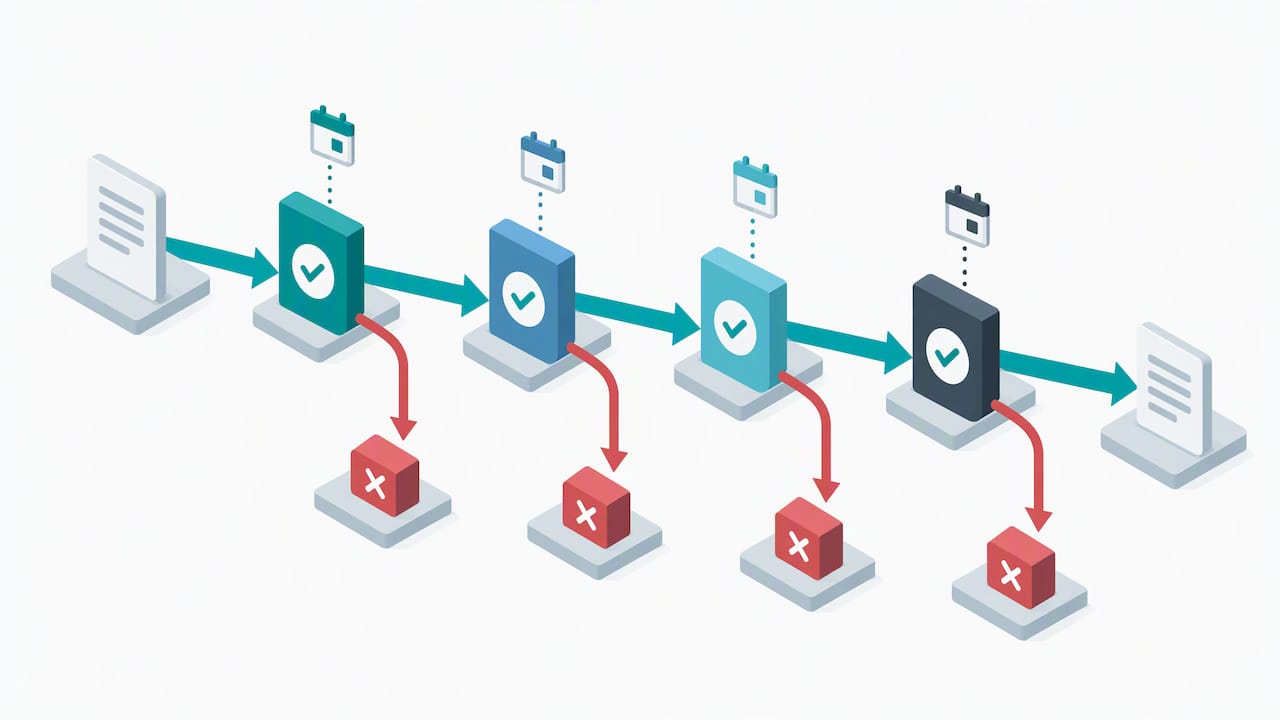
We built Health Code Index around that reality. Our platform supports code search and validation for CPT-4/CCSA and ICD-10, with real-time code and rule updates and API integration with billing and practice management systems. The intention is that administrators spend less time chasing rule changes by hand and more time on the clinical documentation that actually supports a modifier.
Our advice to managers is plain. Treat modifier use as a governance topic rather than a billing trick. Agree one reference for authorised modifiers, train staff on the distinction between 25, 51 and 59, and review a sample of modifier-bearing claims regularly. A modifier you can explain from the record is a modifier that holds up.
— Lumina
How Health Code Index fits into this
If your team validates CPT-4/CCSA claims, you can see how we approach CPT-4 and CCSA rules and modifiers and ICD-10 and CCSA/CPT-4 validation. For teams connecting coding checks to an existing system, our API and HIS integration page explains the approach, and the service overview covers clinical code search, claims processing and claims compliance. Medical schemes and hospitals can also read about our solutions for medical schemes and insurers and for hospitals and provider networks. Pricing is not published, so please contact us through the site for details.
Diagnosis coding sits alongside modifiers in claim quality, so our guide to checking ICD-10 MIT flags before claims is a useful companion.
A practical routine for your billing team
A consistent routine usually beats memorised rules.
- Start from the record. Code what the clinician documented, then decide whether a modifier is needed.
- Check the authorised list. Use the latest CCSA modifier spreadsheet and confirm the 099xx code.
- Check the funder. Look at the scheme’s current rules and any contract-specific terms.
- List modifiers individually. Do not substitute a catch-all code.
- Validate before submission. Run the claim through your validation step.
- Track rejections by modifier. Patterns show which rule or template needs attention.
The AAPC’s Codify tool also offers a crosswalk to check which modifiers are allowed for a given CPT or HCPCS Level II code, on its modifier page. It reflects international coding, so confirm results against the CCSA list.
FAQ
Are CPT-4 modifiers in South Africa the same as in the United States?
The underlying concepts are the same, but the format and the rules differ. CCSA stores modifiers as five-digit 099xx codes, and some AMA-defined modifiers may not be applicable under local funder agreements. Always check the latest CCSA modifier list and the scheme’s rules.
When should I use modifier 59 (09959)?
Use it when two procedures are genuinely distinct, for example separate sessions, sites or incisions, and the clinical record says so. Do not use it only to avoid bundling. If the documentation does not show the separation, the modifier is not supported.
What is the difference between modifier 25 and modifier 59?
Modifier 25 applies to an E/M service that is significant and separately identifiable from a procedure on the same day. Modifier 59 applies to a procedure that is distinct from another procedure. One separates a consultation from a procedure; the other separates two procedures.
Can I list several modifiers on one procedure code?
Yes. PHISC says there is no specified sequence when several apply, but they should be listed individually and not replaced with 09999. Confirm the scheme’s system accepts the number you are sending.
What should I do if a modifier is rejected?
First check the format and whether the modifier is authorised for that code. If the claim is correct, submit a formal appeal that cites the modifier guideline and attaches the clinical documentation, rather than resubmitting unchanged.
Sources
- PHISC CCSA Coding Standards and Guidelines, Version 12 (October 2025)
- PHISC CCSA Coding Standards and Guidelines, Version 11 (October 2024)
- SASCI Coding Guideline Review for 2026
- CMS NCCI Policy Manual 2026, Chapter 1
- AMA Council on Medical Service report
- AMA: Identifying and appealing health insurance claim payment issues
- AAFP Family Practice Management: Enhancing access and payment through proper use of modifiers
- Novitas Solutions: Modifiers, complete listing
- AAPC Codify: CPT and HCPCS modifiers