For most healthcare IT teams, the practical answer is to keep HL7 v2 for internal, high-volume messaging and move to FHIR for APIs, patient-facing access and third-party integration. HL7 v2 moves data as discrete messages between systems, while FHIR exposes data as structured resources over web standards. Many organisations run both at once, and the rest of this article works through the technical trade-offs and migration patterns behind that choice.
Key Takeaways
Most healthcare organisations should keep HL7 v2 for internal messaging and adopt FHIR for patient-facing services and external API integrations to maximise flexibility and efficiency.
| Point | Details |
|---|---|
| Use HL7 v2 for internal feeds | HL7 v2 is reliable for high-volume, event-driven transactions like lab results and patient admissions. |
| Implement FHIR for patient apps | FHIR’s resource-based REST API is better suited for web and mobile applications requiring on-demand data access. |
| Adopt FHIR for partner APIs | FHIR’s standardised REST/JSON interface simplifies third-party access and supports OAuth2 security. |
| Manage hybrid deployments carefully | Using gateways or facades allows real-time translation between HL7 v2 and FHIR without replacing existing systems. |
| Leverage clinical coding tools | Accurate coding validation and integration tools improve data consistency and reduce claim rejections. |
Table of Contents
- What are HL7 v2, HL7 v3/CDA and FHIR?
- Technical comparison: architecture, data, transport and tooling
- Choosing HL7 v2 or FHIR: a practical decision matrix
- Coexistence and migration: gateways, facades and rollout patterns
- Implementation considerations: tooling, security and testing
- Mapping HL7 v2 messages to FHIR resources
- Where clinical coding and integration support reduces mapping friction
- A pragmatic view on choosing between HL7 v2 and FHIR
- Simplify coding and integration alongside your HL7 or FHIR project
- FAQ
- Sources
What are HL7 v2, HL7 v3/CDA and FHIR?
HL7 v2 is a messaging standard built in the 1980s for exchanging clinical and administrative data between hospital systems. It sends discrete, event-triggered messages, such as an admission notice or a lab result, structured as pipe-delimited segments and fields. It remains the backbone of lab, pharmacy and ADT (admission, discharge, transfer) feeds in most hospitals today.
HL7 v3 and its best-known product, the Clinical Document Architecture (CDA), took a document-centric approach using XML. CDA is still common for discharge summaries and care documents in jurisdictions where structured documents, rather than discrete messages, are the exchange unit.
FHIR (Fast Healthcare Interoperability Resources) is a newer specification published by HL7 that represents clinical data as discrete “resources” (patient, observation, medication) accessed over standard web protocols. According to HL7’s own overview, FHIR uses RESTful APIs with JSON, XML or RDF, and can be used stand-alone or alongside earlier HL7 standards.
- HL7 v2: event-driven messages, pipe-delimited text, decades of hospital deployment.
- HL7 v3/CDA: XML-based clinical documents, still used for structured document exchange.
- FHIR: resource-based REST API, built to be implementable without needing to know other HL7 specifications first.
Technical comparison: architecture, data, transport and tooling
The two standards solve interoperability differently, and that difference shapes almost every implementation decision that follows.
Architecturally, HL7 v2 is message-driven: a trigger event (a patient admitted, a result verified) pushes a message to subscribed systems. FHIR is resource and API-driven: a client requests or subscribes to specific resources, such as a single patient’s current medication list, rather than receiving a whole message bundle.
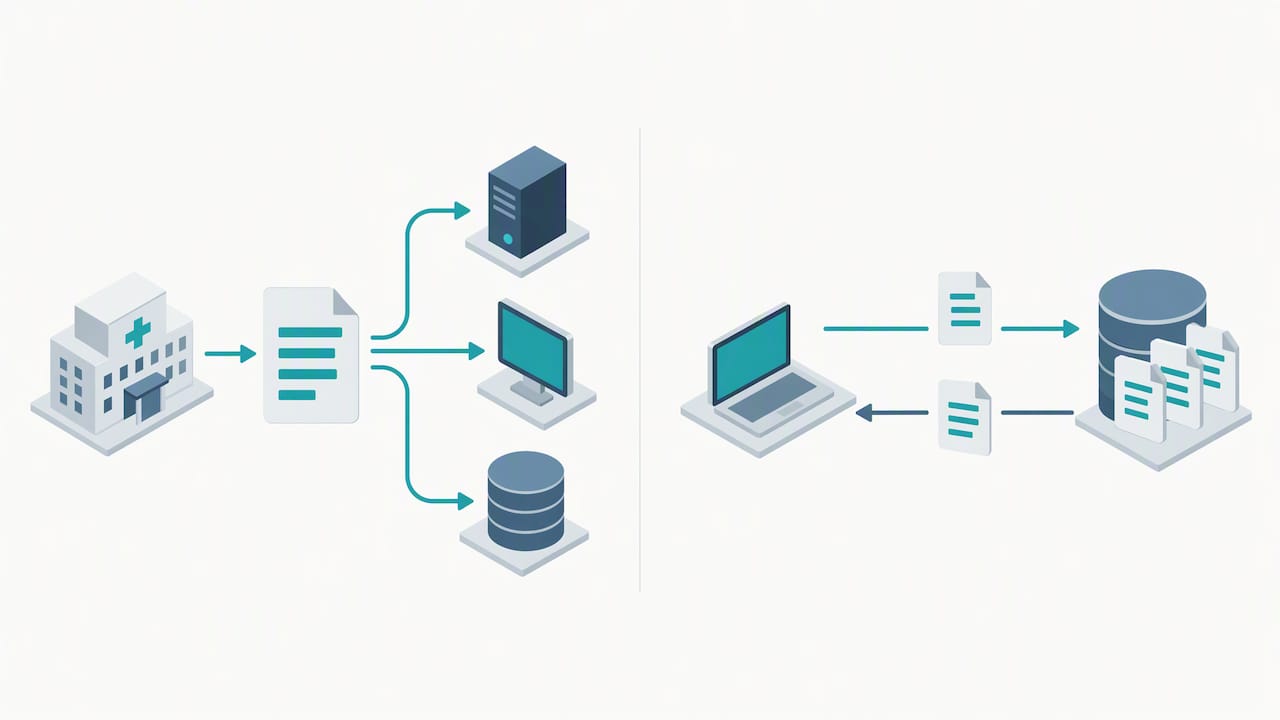
Data modelling differs just as much. HL7 v2 segments and fields allow significant local variability, which is why most v2 interfaces need site-specific configuration. FHIR resources are standardised but extensible, using a defined profiling mechanism and extensions to adapt a base resource to local or national needs without breaking the base structure.
Transport and serialization are the most visible contrast. HL7 v2 traditionally runs over MLLP (Minimal Lower Layer Protocol) with pipe-delimited text payloads. FHIR runs over HTTP/REST, typically serialized as JSON, with XML as an alternative. The FHIR comparison appendix notes that FHIR was deliberately designed so it does not require prior knowledge of other HL7 standards, which lowers the barrier for new developers.
- Conformance: v2 relies on message profiles and local implementation guides; FHIR relies on published profiles, implementation guides and automated validation tooling.
- Tooling: v2 integration engines (interface engines, MLLP listeners) versus REST client libraries, FHIR validators and SMART App Launch libraries.
- Operations: v2 messaging is typically low-latency and reliable for high-volume transactional feeds; FHIR APIs suit on-demand, granular queries rather than bulk transactional throughput.
FHIR represents a scalable, developer-friendly evolution from earlier HL7 standards, and hybrid deployments combining v2 and FHIR are common in production environments according to a structured scoping review of the interoperability landscape.
Choosing HL7 v2 or FHIR: a practical decision matrix
Mapping a business objective to a standard is more useful than debating the standards in the abstract.
- Internal lab, pharmacy and ADT feeds: HL7 v2, because these are high-volume, event-driven transactions where existing v2 infrastructure is proven and stable.
- Patient-facing apps or portals: FHIR, because granular, on-demand resource access over REST fits mobile and web clients far better than batch messaging.
- Third-party or partner API access: FHIR, because external parties expect standard REST/JSON interfaces and OAuth2-based security rather than MLLP connections.
- Regulatory or national reporting feeds: often hybrid, since legacy reporting pipelines may still expect v2 or CDA while new reporting APIs increasingly specify FHIR.
- Enterprise systems replacing or extending legacy interfaces: hybrid, using a FHIR façade in front of existing v2 interfaces to avoid wholesale replacement risk.
When deciding, weigh data granularity needs (whole message versus single resource), latency tolerance, whether external parties need API access, available development skills, and any regulatory reporting format already mandated. A simple checklist helps: assess the business objective first, check what your existing ecosystem and vendors already support, then pilot the chosen approach on a single, low-risk interface before wider rollout.
Coexistence and migration: gateways, facades and rollout patterns
Few organisations switch standards outright. The HL7 comparison documentation states plainly that most standards will coexist for some time, and that FHIR can satisfy needs previously covered by older standards without necessarily replacing them.
A common pattern is the gateway or facade: a translation layer that converts HL7 v2 messages into FHIR resources in real time for API consumers, while leaving the underlying v2 messaging untouched. Real-time translation suits patient-facing queries; batch translation suits reporting or analytics loads where sub-second latency does not matter.
Patient identity matching deserves early attention. A master patient index (MPI) or equivalent matching logic needs to work consistently across both the v2 and FHIR sides of a hybrid architecture, or clinical data can end up linked to the wrong record.
- Start with a pilot interface, not your busiest feed, to validate the gateway pattern safely.
- Add FHIR endpoints incrementally alongside existing v2 interfaces rather than replacing them outright.
- Wrap, rather than replace, v2 interfaces that already perform reliably in production.
Pro Tip: Retain a stable HL7 v2 interface wherever it already performs reliably, and add a FHIR façade in front of it rather than rebuilding the interface from scratch.
Implementation considerations: tooling, security and testing
FHIR’s REST and JSON foundations tend to shorten developer onboarding compared with v2’s segment-and-field conventions, which usually require specialised interface engine knowledge.
Security is where many FHIR projects stumble. FHIR itself does not provide authorization out of the box; project teams need to implement OAuth2 and, for clinical and patient contexts, the SMART on FHIR framework, alongside TLS and audit logging. Treat this as a planned engineering task, not an afterthought.
- Build conformance tests against published FHIR profiles and v2 implementation guides, not just happy-path messages.
- Pay particular attention to custom extensions and local profiles, since these are where most validation failures occur.
- Monitor messaging throughput and reliability for v2 feeds, and API latency and error rates for FHIR endpoints, since the two models fail differently.
Mapping HL7 v2 messages to FHIR resources
Converting v2 to FHIR means mapping segments to resources: a PID segment becomes a Patient resource, an OBX segment becomes an Observation, and repeating fields need careful handling so no clinical detail is dropped in translation.
HL7 publishes a dedicated v2-to-FHIR implementation guide with mapping approaches for implementers working through this conversion.
- Treat optional and repeating v2 fields as the highest-risk area for data loss during conversion.
- Test JSON and XML serializations against representative, real messages rather than synthetic samples, since the two formats are not always perfectly interchangeable for every structure.
- Time-box conversion pilots and run them against a defined test suite before scaling to a full interface.
Where clinical coding and integration support reduces mapping friction
Mapping clinical fields correctly during any HL7 v2 to FHIR project depends on accurate underlying code sets. Our clinical code search and validation tools cover ICD-10, CPT-4/CCSA and PMB indicators, which gives integration teams a reliable canonical source when populating coded elements inside FHIR resources or validating v2 segments before conversion. Real-time code and regulation updates reduce the risk of mapping against outdated code tables, and our API and HIS integration capability connects this validation directly into existing practice management and claims workflows.
A pragmatic view on choosing between HL7 v2 and FHIR
The debate over which standard is “better” misses the point. The question that matters is which business objective you are solving: a stable internal feed, a patient-facing app, or a partner API. Align the decision to your national interoperability framework and your existing ecosystem before touching a protocol spec.
Audit your current interfaces, pilot a FHIR façade on one low-risk feed, and involve your coding and validation processes early rather than at the end of the project. That sequencing reduces rework far more than any standard choice on its own.
— Lumina
Simplify coding and integration alongside your HL7 or FHIR project
Whichever path you choose, your interoperability project still depends on accurate, current clinical codes behind every message and every resource. We offer clinical code search and validation, claims processing, claims compliance checks against standards such as ICD-10, CPT-4/CCSA and PMB indicators, and API-based integration with existing practice management and HIS systems.
- Clinical code search and validation for ICD-10, CPT-4/CCSA and PMB indicators.
- Claims processing and compliance checks built into your existing workflow.
- API and HIS integration that connects coding validation to your practice management system.
| What you need | Where we help |
|---|---|
| Accurate codes for FHIR resources or v2 segments | Clinical code search and validation |
| Fewer claim rejections | Claims processing and compliance checks |
| Direct connection to existing systems | API and HIS integration |
Visit our service overview to see how clinical coding and integration support fits into your HL7 or FHIR project, or review our solutions for IT integration teams to plan a pilot.
FAQ
What is the main difference between HL7 and FHIR?
HL7 v2 exchanges data as event-triggered, pipe-delimited messages, while FHIR exposes data as structured resources accessed through a RESTful web API, typically in JSON or XML. FHIR is published by HL7 and was designed to work alongside, not necessarily replace, earlier HL7 standards.
What are the differences between FHIR and an EHR?
FHIR is an interoperability standard for exchanging healthcare data between systems, not a system in itself. An electronic health record (EHR) is the clinical software that stores patient data, and it may expose that data through a FHIR API for other systems to query.
Is HL7 considered an API?
HL7 v2 is a messaging standard, not an API in the modern REST sense; it exchanges discrete messages over protocols like MLLP. FHIR, which HL7 also publishes, is explicitly API-oriented, using RESTful HTTP operations to query and update resources.
What is the difference between HL7 and DICOM?
HL7 standards (v2, v3/CDA, FHIR) govern the exchange of clinical and administrative data such as orders, results and patient records. DICOM is a separate standard focused specifically on medical imaging, covering how images and related metadata are stored and transmitted.
What does FHIR stand for?
FHIR stands for Fast Healthcare Interoperability Resources, a standard published by HL7 that represents clinical and administrative data as discrete, resource-based objects accessible through a RESTful API.
Sources
- Overview – FHIR v5.0.0
- Deconstructing the interoperability stack: a comparative technical analysis (PMC)
- HL7 v2-to-FHIR implementation guide (BuildFHIR)